Running ads for your roofing business without tracking the right numbers is like climbing a ladder with your eyes closed—you’ll waste energy, take unnecessary risks, and likely miss your goal. Many contractors think “more clicks” or “more impressions” equals success. The truth is, those surface-level stats don’t put money in your pocket. What matters is how efficiently your ad dollars turn into real roofing jobs.
In this article, I’ll break down the five key metrics every roofing business owner must track to stop wasting money and start booking more jobs.
Why Most Roofers Struggle With Ads
Let’s be honest—Google and Facebook make it easy to spend money. You can launch a campaign in minutes, but if you’re not careful, that money disappears faster than a summer storm.
Too many roofers focus only on:
- Clicks (“Wow, my ad got 500 clicks!”)
- Impressions (“10,000 people saw my ad!”)
Neither of these metrics guarantee you’ll get a single booked job. That’s why your ad budget can feel like a gamble.
The good news? Once you start tracking the right numbers, you’ll know exactly what’s working—and what’s not.
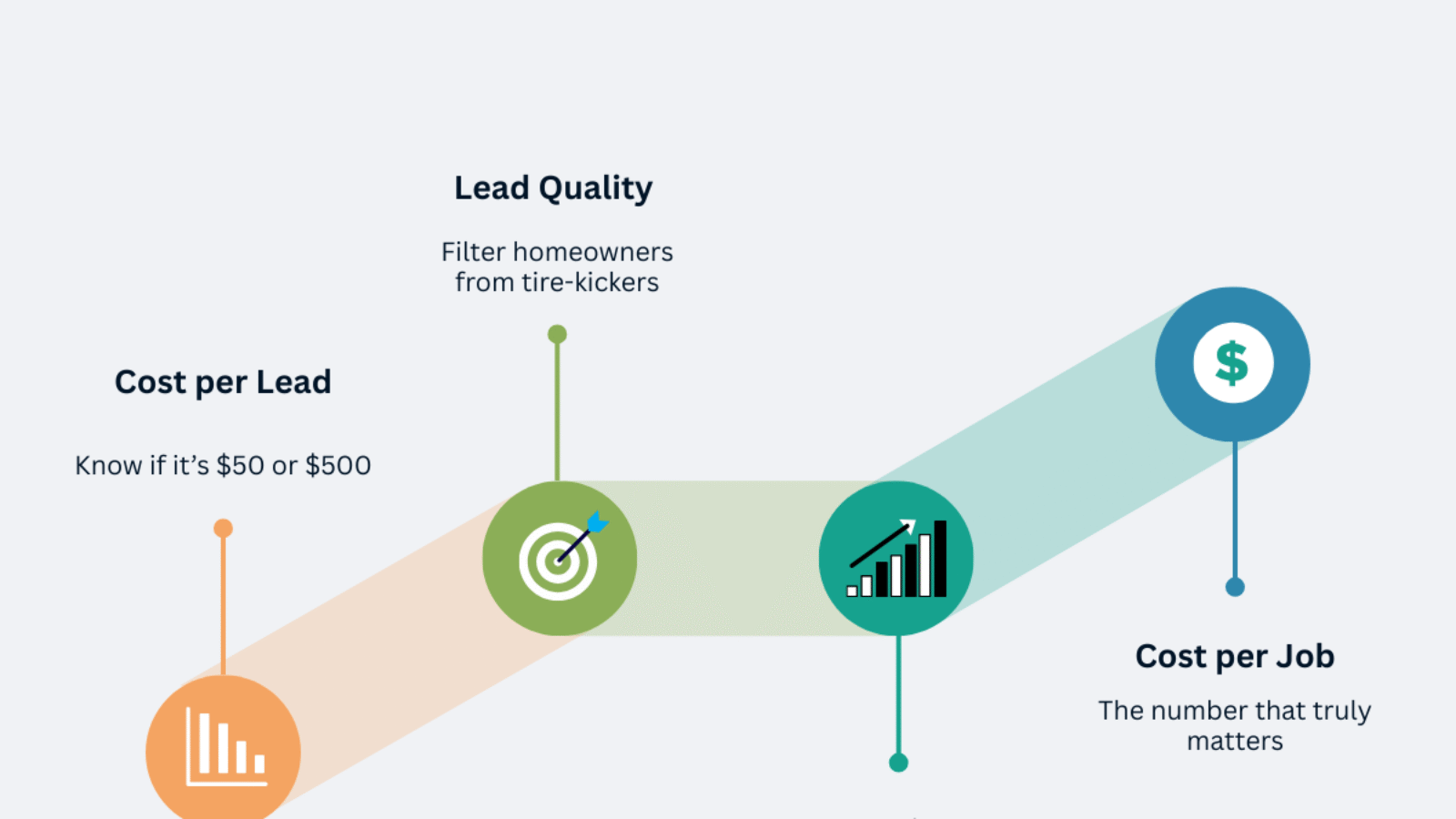
1. Cost Per Lead (CPL)
This is the first number you should care about. It tells you how much you’re paying for each phone call, form submission, or message that comes through your ad.
- Example: If you spend $1,000 on ads and get 20 calls, your cost per lead is $50.
- If another roofer spends the same $1,000 but only gets 2 calls, their cost per lead is $500.
Why it matters: If your CPL is too high, your ads are either targeting the wrong people or the landing page isn’t convincing. Fixing this can save you thousands.
2. Lead Quality
Not all leads are created equal. A curious renter clicking your ad is not the same as a homeowner with a leaking roof.
Signs of low-quality leads:
- People asking general questions but not booking
- Wrong service area inquiries
- Calls from renters, not homeowners
Signs of high-quality leads:
- They’re ready to schedule an inspection
- They own the property
- They’re in your target service area
How to improve quality: Use better ad targeting, clear messaging, and pre-qualifying forms (“Are you the homeowner?”).
3. Conversion Rate
Leads are great, but how many actually turn into booked jobs? That’s your conversion rate.
- Example: You get 20 calls, but only 5 book a job = 25% conversion rate.
- Another roofer gets 20 calls and books 10 = 50% conversion rate.
Why it matters: A higher conversion rate means you’re not just attracting leads—you’re attracting the right leads and closing them effectively.
Pro tip: Train your office staff or sales team on how to handle calls. Many roofing businesses lose jobs not because of bad ads, but because the calls weren’t handled properly.
4. Cost Per Booked Job
This is the number that truly shows whether your ads are profitable.
- Example: You spend $1,000 and book 4 jobs = $250 per job.
- If each job brings in $2,000 profit, your ads are a goldmine.
- But if you spend $1,000 and book only 1 job, you’re at $1,000 per job—that’s tough to sustain.
This is the metric that separates “busy ads” from “profitable ads.”
5. Customer Lifetime Value (LTV)
One of the biggest mistakes roofers make is treating every job like a one-and-done. In reality, one good customer can be worth far more than the first project.
Think long term:
- A roof repair customer may come back for a full replacement in 2–3 years
- Happy customers give referrals (neighbors, family, coworkers)
- Upsells (gutters, siding, maintenance plans) increase revenue
If your average customer is worth $5,000–$10,000 over time, paying $300 to acquire them suddenly feels like a bargain.
Bringing It All Together
Here’s the truth: running ads without tracking these five metrics is like playing poker blindfolded. You might get lucky, but chances are you’ll lose more than you win.
When you know your:
- Cost per lead
- Lead quality
- Conversion rate
- Cost per booked job
- Customer lifetime value
…you gain clarity. You’ll know which ads to scale, which ones to cut, and how much you can confidently invest to grow your business.
Final Thoughts
Roofing is competitive, and the companies winning aren’t necessarily spending the most on ads—they’re the ones tracking the right numbers and making smart decisions.
If you’ve been frustrated by ads that “don’t work” or feel like money disappears without results, it’s time to stop guessing.
👉 Want to see how these five metrics apply to your roofing business? Book a free strategy call today, and I’ll walk you through where your ad dollars are going—and how to turn them into reliable roofing jobs.
Add a Comment