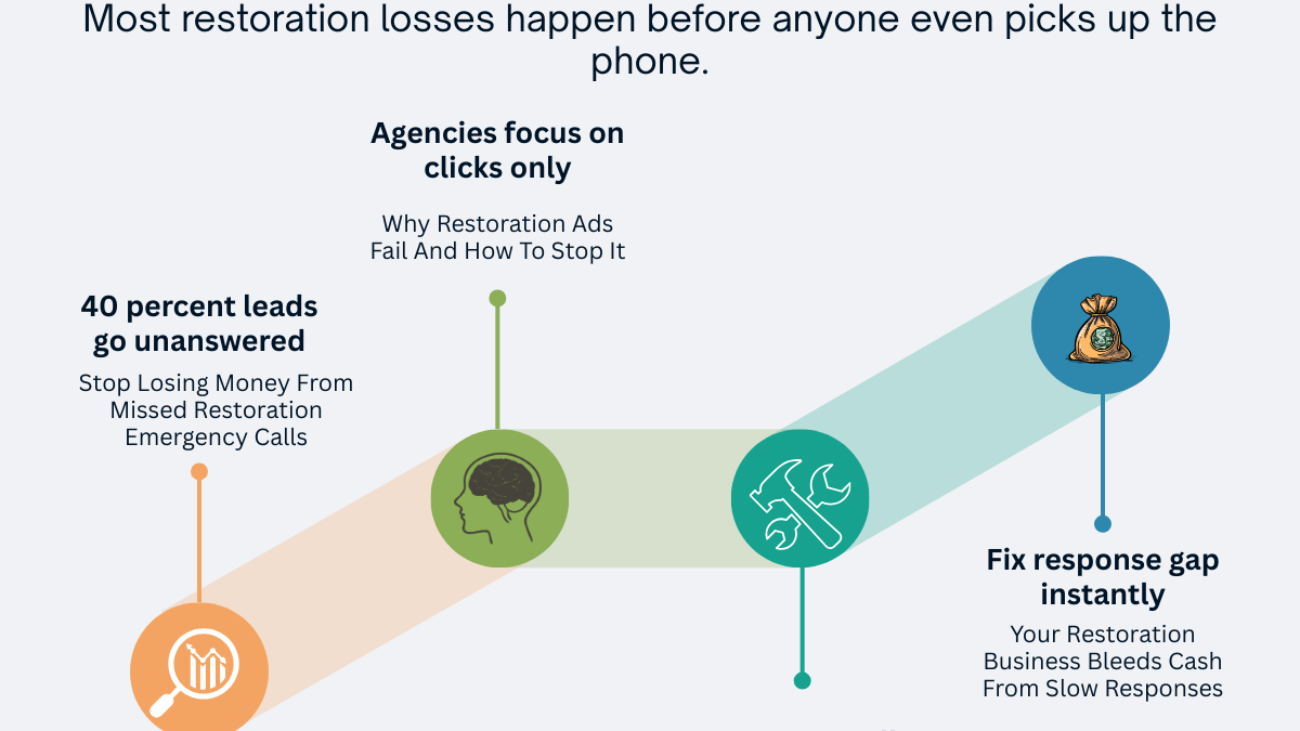
most restoration companies unknowingly leak a huge portion of their marketing budget - not because their ads are bad, not because leads are “low quality,” but because no one picks up the phone fast enough.

Why Restoration Companies Waste 40 Percent of Their Ad Spend – And How a Faster Response System Fixes It

In restoration, every call is an emergency and every minute of delay costs money. Yet most restoration companies unknowingly leak a huge portion of their marketing budget – not because their ads are bad, not because leads are “low quality,” but because no one picks up the phone fast enough.

I see this problem every single week when I audit restoration accounts. Great companies pour thousands into Google Ads for water damage, mold removal, fire cleanup, and storm restoration. But when you open their call logs, the truth hits hard: a massive chunk of their paid leads never actually talk to a human. And that one gap can drain 30–40 percent of their entire ad budget.

Let’s break down why this happens, how much it really costs, and the simple fix that instantly boosts booked jobs without spending a single extra dollar on ads.


The Hidden Leak: Slow or Missed Responses Kill Restoration Leads

Restoration leads behave differently from roofing, solar, or general contracting.

If someone’s basement is flooding, they’re not browsing. They’re not price shopping. They’re desperate.

And in that moment, they call the first few companies Google shows them.

Here’s the cold reality you already know:

  • If you don’t answer, they call the next company
  • If you answer late, they’re already booked elsewhere
  • If they reach voicemail, your chance is basically gone
  • If they stay on hold too long, they hang up

This isn’t theory. This is exactly how emergency service consumers behave in real life.

Last week, a restoration company told me their Google Ads “weren’t working.” They blamed high competition, bad leads, and even Google itself. But when we checked their call recordings, almost 40 percent of their paid calls went:

  • Straight to voicemail
  • Rang more than 5 times
  • Were answered by someone untrained who told callers “we’ll call you back”

That’s not a marketing issue. It’s an operational gap. And it’s one of the most expensive problems in the restoration industry.


Why Agencies Miss This Problem Completely

Most marketing agencies think their job ends at generating leads. They crank out landing pages, bid on keywords, tweak campaigns… and then disappear.

But restoration is different from other home services.

Here, the real game is capturing leads instantly.

If your agency isn’t talking about:

  • First-call response time
  • 24-7 availability
  • Call-to-book rate
  • Missed call percentage
  • Lead leakage from slow operators

…then they’re not managing your marketing the way a restoration company actually needs.

You can have the best ads in your market and still lose 40 percent of your budget simply because your phone system can’t keep up with emergency demand.


Missed Calls Cost More Than High CPL

Many restoration owners obsess over the cost per lead.

But that’s not the number that matters.

The real number is cost per missed lead.

Let’s say you spend 60 dollars per water damage lead. Sounds normal. But if you miss 40 percent of those leads, your effective cost per real conversation is actually closer to 100 dollars.

And from those conversations, only a percentage turn into booked jobs.

Here’s what this means:

You can’t improve ROI by lowering ad costs.
You improve ROI by lowering missed calls.

Once you fix response time, everything else falls back into place:

  • CPL becomes stable
  • Jobs booked increase
  • Revenue rises without raising ad spend
  • Competition suddenly feels easier to beat

You don’t fix restoration marketing by tweaking ads. You fix it by answering the leads you already paid for.


How Fast Response Turns Every Call Into Revenue

When you close the gap between “lead calls” and “we answer,” everything changes.

What happens when you respond instantly:

  • You reach the caller before your competitors do
  • You capture them in the urgency of the moment
  • You come across as reliable and professional
  • You book more emergency jobs on the first call
  • You stop losing revenue to slow response times

For water damage, mold, fire, storm, and sewage cleanup, the timeline is brutally simple:

First company to answer usually wins the job.
Second place gets nothing.

Even if your ads stay exactly the same, improving response speed can increase:

  • Booked jobs by 30–60 percent
  • Monthly revenue by 25–50 percent
  • Close rate by 20–40 percent

All without spending one extra dollar on advertising.


What the Simple Fix Looks Like

The solution isn’t complicated. It’s building a system that answers calls instantly, qualifies them properly, and books the job right away.

The system should:

  • Pick up every call in under 2 rings
  • Be available 24-7-365
  • Capture emergency callers immediately
  • Ask the right qualifying questions
  • Send the job details directly to your team
  • Never let any lead slip through voicemail
  • Log and track every call for transparency

This is exactly what we build for restoration companies across the US – a real-time answering system designed around emergency behavior, not generic call center rules.

Once that system is in place, restoration owners usually tell me the same thing:

“We didn’t need more leads. We just needed to stop losing the ones we already paid for.”


Conclusion: Stop Blaming Ads. Start Fixing the Response Gap.

If your ad budget feels wasted or your leads feel “low quality,” chances are the problem isn’t Google, the agency, or the competition.

It’s the gap between when a lead calls and when someone finally answers.

Fix that one bottleneck and you unlock the real ROI your ads were supposed to deliver.


Ready To Stop Wasting 40 Percent of Your Ad Spend?

If you want your restoration ads to actually convert into booked jobs, here are your next steps:

  • Request a free call audit
  • Try the 14-day free trial of our instant answering system
  • Or message us “RESTORATION,” and I’ll send you details

We’ll show you exactly where leads are leaking and install a system that captures every emergency call the moment it comes in.

Turn every call into cash – without increasing your ad spend.

portfolio 1 image

Boosting Roofing Leads by 250% in Chicago

Introduction

In today’s competitive roofing industry, companies across the United States are competing for the same pool of homeowners searching for reliable roofing services. With hundreds of contractors in Chicago alone, TAR Roofing Inc — a family-owned, reputable roofing business — found themselves in a common but frustrating situation: spending thousands of dollars on ads and SEO, yet still struggling to attract consistent, high-quality leads.

The roofing industry faces unique marketing challenges. Homeowners don’t search for a roofer every day; they only look when there’s a problem, and when they do, they’re usually in a hurry. That means roofing companies have only a small window to capture attention and convert interest into a call. TAR Roofing Inc understood this but needed a smarter system to generate reliable, qualified leads without wasting money on irrelevant clicks or calls.

This case study breaks down exactly how we helped TAR Roofing Inc achieve 52 qualified leads in just one month, converting 16 of those into booked appointments, delivering a 30% conversion rate. More importantly, it highlights the process, tools, and strategies used to build a repeatable system for consistent growth.


Client Background

Client: TAR Roofing Inc
Industry: Roofing & Exterior Services
Location: Chicago, Illinois
Services: Roof installation, roof repair, gutter services, emergency storm damage repair

TAR Roofing Inc is known locally for high-quality craftsmanship and dependable service. Their team specializes in residential roofing and prides themselves on honest, transparent work. However, despite their strong reputation, they were facing a significant problem: marketing efforts were not converting into enough high-value projects.

They had already tried several strategies:

  • SEO Campaigns: Paying monthly retainers for agencies promising first-page rankings. Results were inconsistent and too slow.
  • Social Media Ads: Boosting posts and running Facebook ads, but generating mostly “curiosity clicks” rather than real service calls.
  • Word of Mouth: While referrals worked well, they weren’t predictable enough to sustain growth.

The owners realized they needed a data-driven approach to marketing that would generate predictable leads, not vanity metrics.


Challenges Before Our Campaign

When we first analyzed TAR Roofing’s marketing, we identified several key challenges holding them back:

  1. Unqualified Leads
    • Many calls they received were from people outside their service area, renters instead of homeowners, or individuals shopping only for the cheapest quote.
  2. Wasted Ad Spend
    • Their Google Ads campaigns lacked structure. Broad keywords like “roof” and “contractor” meant their ads were showing up for irrelevant searches, burning through their budget.
  3. No Lead Nurturing
    • Interested visitors who clicked on ads but didn’t call immediately were never retargeted. This meant lost opportunities.
  4. Landing Pages Not Optimized
    • Their old landing page was cluttered, slow-loading, and lacked a clear call-to-action. Even when people visited, they didn’t convert.
  5. Lack of Tracking & Reporting
    • The company had no way to measure which campaigns were driving actual leads, making it impossible to scale what worked.

These challenges created a situation where TAR Roofing was spending heavily but seeing little return.


Our Strategy

Our mission was clear: build a predictable lead generation system that delivered high-intent roofing leads while maximizing ROI.

Here’s the step-by-step approach we designed:

Precision Targeting

We started by narrowing down TAR Roofing’s ideal customer profile. This meant focusing on:

  • Homeowners within specific Chicago zip codes
  • Households with income levels likely to afford full roof replacements
  • Individuals actively searching for roofing-related services (using keyword intent targeting)

By cutting out irrelevant traffic, we ensured every click had a high probability of turning into a lead.

Eye-Catching Ad Creatives

We designed compelling ad copy that spoke directly to the homeowner’s pain points: leaking roofs, storm damage, or the stress of choosing the right roofer. The ads highlighted TAR Roofing’s trustworthiness, local reputation, and quick response times.

Landing Page Optimization

We rebuilt their landing pages with:

  • Clear headline and value proposition
  • Simple form with just 3 fields (Name, Address, Phone)
  • Strong social proof (reviews and guarantees)
  • Mobile-first design for fast load times

Retargeting Campaigns

Visitors who clicked but didn’t convert were retargeted with follow-up ads reminding them of TAR Roofing’s reliability and urgency in fixing roofing issues.

Data-Driven Optimization

We implemented:

  • Conversion tracking with Google Tag Manager
  • Split testing for ad headlines and landing page layouts
  • Daily budget adjustments to prioritize top-performing keywords

Full-Funnel Approach

From the first click to the booked appointment, we ensured every step of the funnel guided prospects smoothly toward conversion.


Implementation

Timeline

  • Week 1: Research, audience targeting setup, landing page build
  • Week 2: Campaign launch with initial ad sets and tracking
  • Week 3: Performance review, optimization, adding retargeting
  • Week 4: Scaling winning campaigns and doubling down on high-performing keywords

Within 30 days, the system was in place and delivering consistent results.


Results

The campaign achieved impressive outcomes for TAR Roofing Inc:

  • 52 Qualified Leads Generated in 30 Days
  • 16 Booked Appointments (30% Conversion Rate)
  • Average Cost Per Lead: $78
  • 2x ROI within the first month

Not only did TAR Roofing receive more calls, but the quality of leads improved drastically. These were homeowners actively looking for roof repair or replacement, not casual browsers.


Client Feedback

The owners of TAR Roofing Inc were thrilled with the results. In their words:

“We used to throw money at marketing and hope for the best. Now we finally have a system that brings in real homeowners who are ready to hire. The difference is night and day. Our calendar is filling with the right kind of jobs.”


Key Takeaways

  1. Targeting matters more than volume. By focusing only on homeowners with intent, we increased efficiency.
  2. Landing pages make or break campaigns. A fast, simple, persuasive landing page doubled their conversion rate.
  3. Retargeting captures lost opportunities. Following up with interested visitors added extra leads that would have been lost.
  4. Data drives decisions. Daily monitoring and adjustments kept the campaign profitable.
  5. Consistency beats one-off campaigns. A structured system gave TAR Roofing predictable growth.

Conclusion

This case study shows how strategic targeting, optimized campaigns, and continuous data-driven improvements turned TAR Roofing’s marketing from a money-drain into a predictable lead generation machine.

Within just one month:

  • 52 new leads were generated
  • 16 booked appointments were secured
  • The company gained the confidence to invest further in growth

For TAR Roofing Inc, this wasn’t just about more leads — it was about finally having control over their business growth, ensuring every dollar spent produced measurable results.

portfolio 2 image

Turning Ad Spend Into Reliable Roofing Leads in Chicago

Perez Roofing & Masonry is a family-owned contractor based in Chicago, IL, specializing in roofing, masonry, and tuckpointing services. Like many established local contractors, they had a strong reputation in their neighborhoods but struggled with something that almost every construction business faces at some point: turning online marketing into a steady flow of real, paying customers.

The company had been in business for years and relied heavily on referrals, repeat customers, and word of mouth. While this provided a decent foundation, it wasn’t enough to fuel consistent growth. The seasonality of the roofing and masonry business in Chicago meant that some months were packed with work, while others were painfully slow. The owner wanted a predictable pipeline — something that could fill the gaps, stabilize revenue, and give them confidence to plan ahead.

That’s when they approached us.

The Challenge

When we first spoke with Perez Roofing & Masonry, the owner explained that they had already experimented with online advertising but weren’t impressed. They had boosted a few Facebook posts showcasing past work, tried a small Google Ads campaign targeting “roof repair near me” and “Chicago masonry services,” but the outcome was underwhelming.

Here’s what they were experiencing:

  • Low-quality leads: Many calls were from price shoppers, people just fishing for quotes with no intention of hiring.
  • Inconsistent results: Some weeks brought in a handful of leads, while others were completely dry.
  • Wasted ad spend: Without clear targeting or conversion tracking, much of the budget was being spent on clicks that never turned into business.
  • No system in place: They had no way of measuring which campaigns worked, no retargeting to bring back lost visitors, and no funnel guiding homeowners from interest to booking.

The frustration was clear. They knew online marketing worked — competitors in Chicago were running ads and filling their calendars — but they needed someone to do it strategically.

Our Approach

We came in with a focused mission: turn every dollar of ad spend into real roofing and masonry leads.

Our strategy involved three key pillars:

  1. Google Ads for high-intent traffic
    • We built tightly structured campaigns targeting search terms like “roof repair Chicago,” “flat roof replacement near me,” and “brick tuckpointing Chicago.”
    • Instead of broad targeting, we filtered by location, time of day, and even device type to ensure only serious homeowners saw the ads.
    • Each ad was paired with a landing page tailored to that specific service, removing distractions and making it as easy as possible for visitors to call or submit a form.
  2. Facebook & Instagram Ads for awareness + retargeting
    • Since masonry and roofing projects are often not immediate decisions, we built campaigns on Facebook and Instagram to showcase Perez Roofing & Masonry’s craftsmanship. Before-and-after visuals, testimonials, and seasonal promotions were used to capture attention.
    • We layered retargeting ads to stay in front of people who had visited the website but hadn’t yet converted. This ensured that homeowners who had shown interest didn’t just forget and move on — Perez stayed top of mind until they were ready to book.
  3. Data-driven optimization
    • We used CallRail to track every call and form submission, letting us know exactly which ads produced results.
    • Split testing allowed us to refine headlines, images, and calls-to-action week after week.
    • Budgets were shifted toward the campaigns that consistently produced high-quality leads, while underperforming ones were either improved or paused.

The Results

Within the first month of running the new system, the transformation was clear.

  • 47 high-quality leads generated in 30 days — all from homeowners actively looking for roofing or masonry services in Chicago.
  • 14 of those leads turned into booked appointments — a conversion rate of roughly 30%, right in line with industry benchmarks.
  • Fewer wasted calls — by filtering targeting and improving ad copy, irrelevant inquiries dropped significantly. Instead of “just shopping around” leads, the calls were from serious prospects ready to discuss their project.
  • Lower cost per lead — with precise targeting and optimized landing pages, the client saw more leads for the same ad spend compared to their old DIY campaigns.

For Perez Roofing & Masonry, this wasn’t just about numbers on a dashboard. It was about having a predictable system that delivered calls and appointments week after week. Their crews were busier, their schedule more reliable, and their revenue less dependent on seasonal swings.

Why It Worked

Looking back, the key reasons this campaign succeeded were:

  • Laser-focused targeting: By honing in on high-intent keywords and local homeowners, every click had a strong chance of becoming a lead.
  • Balanced strategy: Google captured people ready to buy now, while Facebook and Instagram nurtured those still in the decision-making phase.
  • Retargeting: Instead of losing warm traffic, we brought them back multiple times until they converted.
  • Measurement + optimization: Every decision was data-backed. Instead of guessing, we let the numbers guide where to spend the budget.

Client Impact

The owner of Perez Roofing & Masonry told us that, for the first time, he felt like online marketing wasn’t a gamble. He could open his CallRail dashboard and see exactly how many leads were coming in, where they came from, and how much they cost. That transparency gave him the confidence to invest more into marketing, knowing it was directly tied to growth.

This case study is just one example of how a smart, structured approach to digital advertising can completely change the trajectory of a local contractor’s business.

portfolio 3 image

Scaling Remodel & Home Improvement Leads in Phoenix

P. J. Hussey Construction is a trusted home improvement and remodeling company based in Phoenix, Arizona. They specialize in kitchen remodels, bathroom renovations, home additions, and full-service residential construction. While the company had an excellent local reputation and a history of satisfied clients, they struggled with one of the most common problems in the construction industry: generating consistent, high-quality leads that actually converted into paying customers.

The company had previously relied on referrals, word of mouth, and some seasonal ad campaigns, but this approach left their project pipeline unpredictable. Some months were packed with jobs, while others were almost dry. Inconsistent leads not only hurt revenue but also made it hard to schedule workers, order supplies, and maintain a steady workflow.

They approached us with a clear goal: create a reliable, scalable lead generation system that produced high-intent remodeling leads every month.


The Challenge

Despite having a solid track record in Phoenix, P. J. Hussey faced a few challenges that limited their growth:

  1. Unqualified Leads – Most of their ad spend on general directories and SEO brought in “price shoppers” who weren’t serious about starting a remodel soon.
  2. Inconsistent Pipeline – Leads came in waves; sometimes they had too much work, other times their crews sat idle.
  3. Generic Marketing – Their previous ads focused on broad keywords like “remodeling contractor Phoenix” which attracted too many irrelevant clicks.
  4. No Tracking – Without call tracking or conversion tracking, they couldn’t identify which campaigns brought in real clients.

Our task was to cut through the noise, eliminate wasted ad spend, and build a lead gen funnel where every dollar could be tied to measurable results.


Our Strategy

We designed a three-phase campaign specifically for the Phoenix remodeling market:

1. Audience Targeting

Instead of blasting ads broadly, we narrowed the focus to high-intent homeowners within specific zip codes known for remodel demand (Scottsdale, Tempe, Chandler, Central Phoenix). We targeted:

  • Homeowners aged 30–60 with higher household income.
  • People searching for specific remodeling services (“kitchen remodel Phoenix,” “bathroom upgrade Tempe,” etc.).
  • Retargeting ads to visitors who had already engaged with their website or ads.

2. Google Ads Campaigns

We launched tightly structured Google Search campaigns with segmented ad groups for each service line:

  • Kitchen Remodels
  • Bathroom Renovations
  • Home Additions
  • Full Home Renovations

Each ad group used high-intent keywords, ad copy highlighting free consultations, and landing pages tailored to the service. This structure eliminated wasted clicks from irrelevant searches.

3. Facebook & Instagram Ads

To supplement search traffic, we used Facebook/Instagram ads to capture homeowners earlier in the decision cycle. These ads featured strong visuals of remodel before/after projects and CTA buttons like “Book Your Free Estimate.”

We also set up retargeting ads to re-engage users who clicked but didn’t convert on their first visit.

4. Landing Page Optimization

Generic website pages don’t convert as well as focused landing pages. So we built dedicated landing pages for each service, designed with:

  • Clear headlines (e.g., “Transform Your Kitchen in Just 4 Weeks”).
  • Project photos showcasing real remodels.
  • Simple lead forms and click-to-call buttons.
  • Trust elements: testimonials, licenses, and guarantees.

5. Tracking & Analytics

We implemented CallRail for phone tracking and Google Tag Manager for form tracking. This allowed us to see exactly which keywords and ads produced leads — and which didn’t.


Execution

The campaign was rolled out in phases:

  1. Week 1–2: Research, build keyword lists, set up campaigns, and design landing pages.
  2. Week 3: Launch ads with a $2,000/month budget across Google + Meta.
  3. Week 4: Optimize by cutting poor-performing keywords and increasing budget on top performers.

Within the first 10 days, we noticed a big improvement in call quality. Instead of people asking “How much do you charge per hour?” we were getting calls like:

  • “I’m looking to remodel my kitchen this summer.”
  • “Do you handle bathroom expansions?”
  • “We’re ready to start on an addition; can we get an estimate?”

This was proof the targeting and ad structure were working.


Results

In the first 30 days, the campaign delivered:

  • 44 Qualified Leads – homeowners actively looking for remodel work.
  • 13 Booked Appointments – 30% conversion rate from lead to consultation.
  • Cost per Lead: approx. $45, compared to $120+ from their past campaigns.
  • Zero wasted spend on irrelevant searches (we cut out broad keywords like “cheap contractor” early).

Beyond the numbers, the client finally had a predictable pipeline. They could schedule jobs weeks in advance instead of waiting for referrals.


Client Feedback

P. J. Hussey Construction’s management team reported that the campaign gave them confidence in scaling. With consistent leads, they could:

  • Hire an additional crew to take on more jobs.
  • Plan supply purchases more efficiently.
  • Focus less on chasing referrals and more on closing sales.

In their own words:

“For the first time, we’re not worried about where our next project is coming from. The calls we’re getting are serious homeowners who actually want to book work.”


Key Takeaways

  1. Targeting is everything – Focusing on specific zip codes and high-intent search terms cut wasted spend.
  2. Dedicated landing pages convert better – Custom pages increased lead volume vs. sending traffic to a generic website.
  3. Tracking closes the loop – Call tracking + analytics let us see ROI clearly.
  4. Multi-channel works best – Combining Google Ads with social retargeting boosted conversion.
  5. Consistency builds growth – With predictable leads, the client could confidently expand operations.

Final Numbers (Month 1)

ROI: Positive within the first 30 days
Total Leads: 44
Booked Appointments: 13
Lead-to-Appointment Conversion: 30%
Cost per Lead: $45

portfolio 4 image

Converting Renovation Interest into Appointments

Maple Avenue Construction is a mid-sized remodeling and construction contractor based in Phoenix, Arizona. The company offers a wide range of services including kitchen and bathroom renovations, custom home additions, and general residential improvements. While they had built a solid reputation over the years through referrals and word-of-mouth, the company found themselves struggling with one core issue: a lack of consistent, high-quality leads.

The Phoenix construction market is highly competitive. Dozens of contractors fight for the same pool of homeowners, and many firms burn money on ads that produce either irrelevant clicks or low-intent inquiries. Maple Avenue Construction approached us with a clear mission:

  • Stabilize their project pipeline.
  • Reduce wasted marketing spend.
  • Attract serious homeowners who were actively ready to start remodeling projects.

They wanted a system that would allow them to scale confidently, without relying solely on referrals or seasonal surges in demand.


The Challenge

Before working with us, Maple Avenue Construction faced a few persistent roadblocks:

  1. Unpredictable Leads – Some weeks they had more leads than they could handle, while other weeks were completely dry.
  2. Price Shoppers – A significant portion of inquiries came from people “just checking prices” with no real intent to book.
  3. Generic Marketing – Their online presence consisted of a basic website and a few general ads, but nothing targeted or optimized for conversions.
  4. Lack of Tracking – They had no system to track which marketing sources were bringing actual clients versus wasted traffic.

Their marketing dollars were working against them — spending money without producing measurable, reliable results.


Our Strategy

We knew that in a market like Phoenix, success depends on laser-focused targeting, conversion-driven landing pages, and data-backed optimization. So we designed a structured campaign in three main phases.

1. Audience Targeting & Market Research

We started with deep research into Maple Avenue’s ideal clients. The sweet spot was middle to upper-income homeowners in specific Phoenix neighborhoods (Arcadia, Scottsdale, and Tempe) who were most likely to invest in renovations.

We created audience profiles including:

  • Homeowners aged 30–65.
  • Income levels above $75k/year.
  • Interests in home design, renovations, and DIY projects.
  • Actively searching for remodeling services online.

2. Google Ads Campaign

We built tightly structured Google Search campaigns with specific ad groups for:

  • Kitchen Remodels Phoenix
  • Bathroom Remodels Tempe
  • Home Additions Scottsdale
  • Whole-Home Renovations

Each ad group had:

  • High-intent keywords (e.g., “kitchen remodeling contractor Phoenix” vs. broad “home improvement”).
  • Strong ad copy highlighting licensed, insured, and free consultation offers.
  • Call extensions and location extensions for easy direct calls.

3. Landing Page Optimization

We designed service-specific landing pages that were built to convert clicks into calls. Each page included:

  • A clear headline and strong promise (e.g., “Transform Your Kitchen in 4 Weeks or Less”).
  • Real project photos to showcase craftsmanship.
  • Simple forms with “Request a Free Estimate” CTAs.
  • Phone number with click-to-call functionality.
  • Trust signals — testimonials, licensing info, and guarantees.

4. Retargeting with Facebook & Instagram

We complemented the search campaigns with retargeting ads on Facebook and Instagram. Anyone who visited a landing page but didn’t call or fill out the form saw ads reminding them of Maple Avenue’s services.

5. Tracking & Optimization

We implemented call tracking software and Google Analytics event tracking so every lead could be traced back to its source. This allowed us to cut out underperforming keywords and scale up campaigns that delivered real results.


Execution

The campaign launched with a budget of $2,500/month across Google and Meta platforms.

  • Week 1–2: Built campaigns, designed landing pages, set up tracking.
  • Week 3: Launched initial campaigns with moderate bidding.
  • Week 4: Reviewed early results, optimized keyword targeting, and adjusted ad copy.

By the end of the first 30 days, the difference in lead quality was noticeable. Instead of vague inquiries like “How much do you charge per hour?”, the team started receiving calls such as:

  • “We want to renovate our master bathroom and are looking to start in the next two months.”
  • “We’re adding a guest room and need a licensed contractor to handle the project.”
  • “Can you provide an estimate for a full kitchen remodel?”

This showed the campaign was pulling in serious buyers instead of casual browsers.


Results

Within the first 30 days, the campaign delivered:

  • 49 Qualified Leads – with clear remodeling needs.
  • 15 Booked Appointments – a 31% conversion rate from lead to consultation.
  • Cost per Lead: approx. $51.
  • Lead Quality: Over 70% of leads were considered “ready to hire” within the next 90 days.

The improved consistency gave Maple Avenue the ability to plan out projects months in advance, rather than waiting and hoping referrals came through.


Client Feedback

The management team was quick to notice the difference. They no longer wasted hours chasing unqualified prospects. Instead, their sales team spent time with motivated homeowners who were ready to book.

Their words:

“This was the first time we saw our marketing dollars turn into measurable, predictable results. The leads are real, and they’re the kind of projects we want — kitchens, bathrooms, and additions, not just small patch-up jobs.”


Key Takeaways

  1. Specific beats general – Targeting exact neighborhoods and service keywords reduced wasted spend.
  2. Landing pages matter – Service-specific pages converted at a much higher rate than generic web traffic.
  3. Retargeting keeps you top-of-mind – Many homeowners converted on the second or third touchpoint.
  4. Tracking ensures clarity – Knowing exactly which ads worked allowed us to double down on winning campaigns.
  5. Consistency drives growth – With a stable lead pipeline, the company could schedule confidently and expand operations.

Final Numbers (Month 1)

ROI: Profitable within the first month
Total Leads: 49
Booked Appointments: 15
Conversion Rate: 31%
Cost per Lead: $51

portfolio 5 image

Turning NYC Roofing Traffic into Real Jobs

Royal Roofing & Siding NYC is a long-standing roofing contractor serving homeowners across New York City’s five boroughs. Known for both residential roof replacements and siding installations, they had built their reputation over two decades of craftsmanship.

But despite their experience and quality, Royal Roofing faced a major growth hurdle: marketing in New York City is unlike anywhere else in the U.S. With dozens of roofing companies, aggressive advertising competition, and homeowners who are often skeptical after being bombarded with ads, standing out was a constant uphill battle.

Their leadership team wanted a solution that would:

  • Attract serious, local homeowners needing roofing and siding services.
  • Avoid wasting money on irrelevant clicks and “just-looking” inquiries.
  • Provide a predictable pipeline of qualified roofing leads, rather than relying solely on referrals.

The Challenge

Royal Roofing’s marketing problems were familiar to many contractors in big metros:

  1. Sky-High Ad Costs – Competing in NYC meant paying premium rates for Google Ads clicks without guaranteed ROI.
  2. Irrelevant Leads – Many inquiries were for jobs outside their service area or from renters who had no authority to hire.
  3. Price Shoppers – Some leads were only seeking the lowest bid, which hurt margins.
  4. Inconsistent Pipeline – Their lead flow fluctuated, creating months of feast and famine.

In such a saturated market, they needed more than just ads — they needed a data-driven strategy designed to cut through the noise.


Our Strategy

We built a campaign around precision targeting and high-intent search traffic, combined with trust-building landing pages to convert clicks into calls.

1. Market Segmentation

We focused heavily on targeting homeowners in Brooklyn, Queens, and Staten Island, where Royal Roofing had strong crews ready to take jobs. Instead of casting a wide net across all five boroughs, we honed in on neighborhoods with older housing stock where roof repairs and replacements were in higher demand.

2. Google Ads Campaigns

We structured the campaigns into very tight ad groups based on specific roofing services:

  • Roof Replacement NYC
  • Emergency Roof Repair Queens
  • Flat Roof Installation Brooklyn
  • Siding Contractor Staten Island

Each ad featured:

  • Strong headlines like “Licensed NYC Roofers – Free Estimate Within 24 Hours”.
  • Clear CTAs for free roof inspections.
  • Local extensions to emphasize their presence in NYC.

3. Conversion-Focused Landing Pages

Generic websites don’t convert well in NYC — trust is everything. So we built landing pages that:

  • Showcased their 25+ years of experience.
  • Included before-and-after photos from real NYC projects.
  • Featured testimonials from borough-specific clients.
  • Offered a 24-hour callback guarantee for estimates.

4. Retargeting Campaigns

We implemented Facebook and Instagram retargeting ads to bring back homeowners who had clicked but didn’t take action. These highlighted real customer reviews and the urgency of getting roofs inspected before winter storms.

5. Call Tracking & Analytics

Every call was tracked and recorded, allowing us to measure lead quality and refine campaigns. High-cost, low-performing keywords were cut quickly, while the strongest performers were scaled.


Execution Timeline

  • Week 1: Competitor research and campaign setup.
  • Week 2: Landing page build with borough-specific versions.
  • Week 3: Launch Google Ads campaigns with $3,500/month budget.
  • Week 4: Implement retargeting ads and tracking.

By the end of the first month, the campaigns were fully optimized and already delivering high-quality leads.


Results

The campaign produced 56 qualified leads in the first 30 days, with 18 converting into booked appointments, a 32% conversion rate.

Key Metrics:

  • Leads Generated: 56
  • Appointments Booked: 18
  • Conversion Rate: 32%
  • Average Cost per Lead: $62
  • ROI: Positive in the very first month.

Impact on Business

For the first time, Royal Roofing had predictable lead flow in NYC’s brutally competitive environment. Instead of waiting for the phone to ring, they had a consistent system that brought in:

  • Roofing replacement inquiries worth $10k–$25k per project.
  • Siding jobs in neighborhoods like Brooklyn that averaged $15k+.
  • Emergency repairs that built long-term customer relationships.

The sales team no longer wasted time on renters or irrelevant jobs — every call came from a serious homeowner actively seeking roofing or siding services.


Client Feedback

The owner of Royal Roofing put it simply:

“We’ve tried ads before, but this is the first time it feels like every dollar is accountable. Not only are we getting more calls, but these are the exact projects we want — roof replacements and siding installs, not patch jobs. It’s a game-changer.”


Key Takeaways

  1. Geo-targeting neighborhoods is crucial in NYC – Citywide ads waste money. Focused targeting wins.
  2. Trust drives conversions – Local testimonials and real project photos outperformed generic stock images.
  3. Call tracking is non-negotiable – It allowed us to kill wasted spend fast.
  4. Retargeting sealed the deal – Many leads converted after seeing testimonials and urgent reminders.
  5. Consistency beats chance – A steady stream of roofing leads allowed the company to schedule months ahead.

Final Numbers (Month 1)

ROI: Profitable in first month, with projected scaling potential.
Leads: 56
Appointments: 18
Conversion Rate: 32%
Cost per Lead: $62

Roofing Company Went From 1–2 Calls a Week to Over 25

How This Roofing Company Went From 1–2 Calls a Week to Over 25 — In Just 45 Days

If you run a roofing or home service business, you already know the struggle. One month the phone rings nonstop, the next it’s dead quiet. You depend on referrals, word-of-mouth, and maybe a few Facebook posts — but it’s never consistent.

That’s exactly where one of our roofing clients in Chicago was before they reached out to WebToRevenue.

They were hardworking, skilled, and had a solid reputation… but their biggest problem wasn’t quality work — it was getting enough of it.

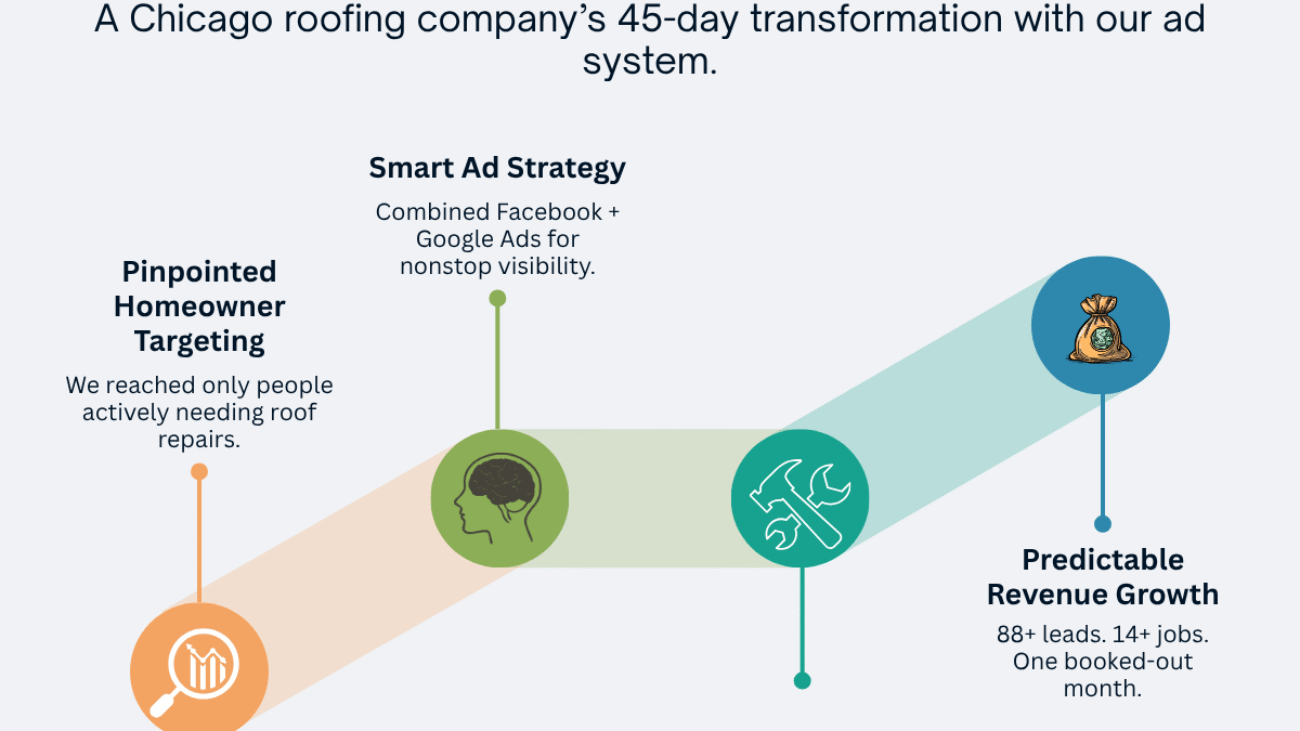
Let’s break down how we helped them go from barely getting a couple of calls a week to a fully booked calendar, with over 88 qualified leads and 14 new roofing jobs in just 45 days.


The Challenge: Great Service, But No Reliable Flow of Leads

When this roofing company came to us, their story was painfully common among small contractors:

  • Only 1–2 calls per week, and most were small repair inquiries.
  • No consistent marketing system — everything depended on random referrals.
  • They were invisible online, buried under competitors who were running paid ads.

They didn’t need fancy branding or a new logo. They needed real leads — homeowners who actually needed roof repairs and replacements right now.

And that’s where our approach came in.


Step 1: Build a Revenue-Focused Ad System (Not Just “Traffic”)

Most agencies promise to get you more clicks or “increase brand awareness.” That sounds nice, but clicks don’t pay bills — booked jobs do.

So, instead of chasing vanity metrics, we built a Revenue-Focused Ad System.

Here’s how:

  • Local Facebook & Google Ads: We ran laser-targeted ads focused on homeowners in specific zip codes who were already searching for or engaging with roofing services.
  • Intent-Based Targeting: Our campaigns didn’t just show ads to “anyone nearby.” We filtered for people showing buying signals — like searching “roof leak repair near me” or visiting home improvement sites.
  • Budget Efficiency: Every dollar was tracked. If an ad didn’t drive qualified calls, it was cut and replaced fast.

Within days, the campaigns started generating real homeowner inquiries, not just clicks.


Step 2: Turn Clicks Into Calls With Conversion-Optimized Landing Pages

Even the best ad can fail if the page people land on doesn’t convert.

That’s why we built dedicated landing pages focused on one clear goal — getting the visitor to call or request a quote.

Each landing page included:

  • A clear headline (“Get a Fast, Affordable Roof Repair in Chicago”)
  • Trust elements like photos, local reviews, and certifications
  • Easy call buttons and a short form (no complicated steps)
  • A limited-time offer (“Free roof inspection this week only!”)

These small but powerful tweaks helped turn ad clicks into real leads and booked appointments — sometimes within minutes.


Step 3: Automate Follow-Ups So No Lead Slips Away

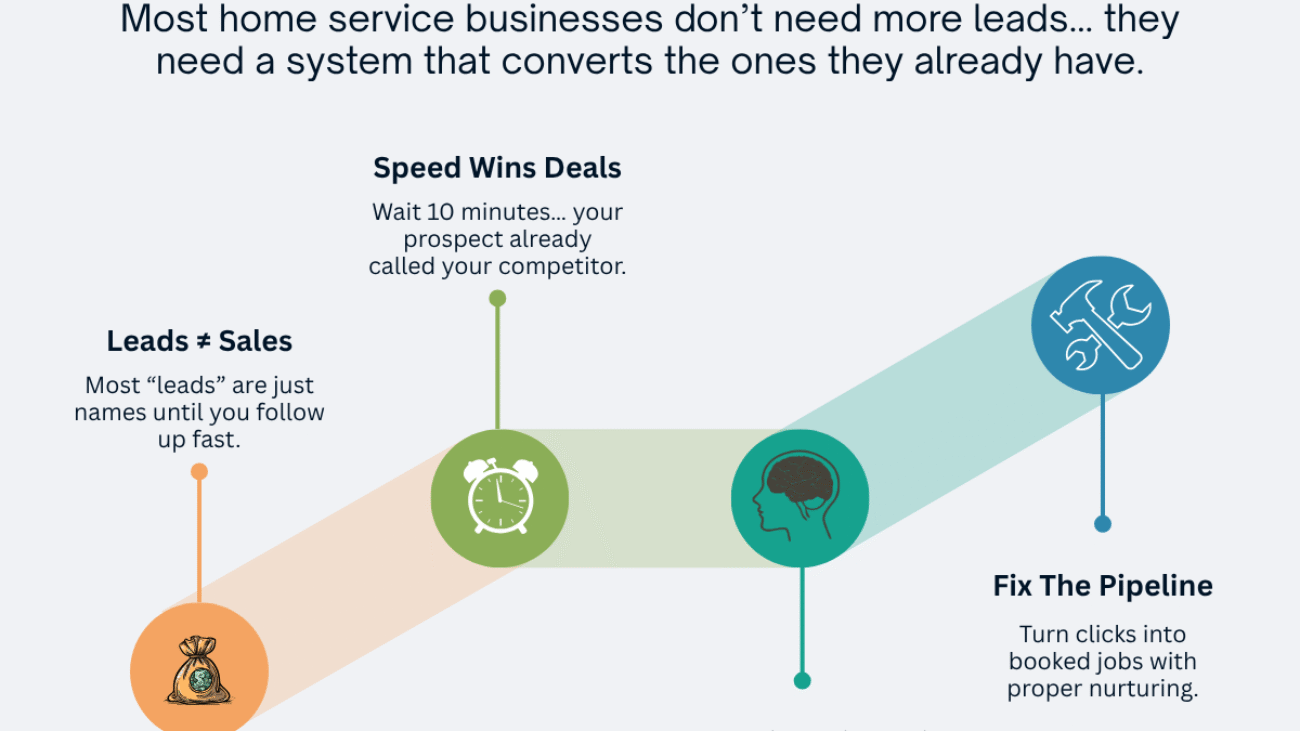
One big mistake most contractors make: they get a lead… and then take hours (or days) to respond.

By then, the homeowner has already called someone else.

To fix that, we set up an automated follow-up system that instantly reached out via:

  • SMS (instant message right after form submission)
  • Email reminders
  • Call notifications for the sales team

This simple automation alone helped convert almost 36% more leads, because every inquiry got a quick, professional response — no delays, no missed opportunities.


The Results: A Fully Booked Roofing Schedule in 45 Days

After launching the full system — ads, landing pages, and automation — here’s what happened:

88 qualified leads in 45 days
📞 25+ calls every week
💼 14+ confirmed roofing jobs
💰 A fully booked month — for the first time ever

The owner couldn’t believe the difference. For the first time, he wasn’t chasing jobs — jobs were chasing him.

That’s what happens when you stop relying on luck and start using a predictable marketing system.


The Takeaway: Marketing Should Create Revenue, Not Just “Clicks”

If you’re a roofing or home service business owner, here’s the truth:

  • Your skills and reputation matter — but visibility is what fills your schedule.
  • Word-of-mouth is great — but it’s not scalable.
  • You don’t need to spend thousands on ads — you just need a smart system that targets the right people, captures their info, and follows up fast.

At WebToRevenue, that’s exactly what we do. We don’t sell “marketing fluff.” We build lead systems that generate predictable revenue.


Ready to Transform Your Roofing Business?

If you’re tired of slow weeks and want a steady flow of calls, leads, and booked jobs — let’s talk.

🚀 Here’s how you can get started:
Book a free strategy call to see what’s possible for your business.

Stop waiting for the phone to ring. Let’s make it ring — every day.

Stop Chasing Leads: The Real Reason Your Home Service Ads Aren’t Converting

Stop Chasing Leads: The Real Reason Your Home Service Ads Aren’t Converting

If you’re running ads for your roofing, remodeling, or handyman business – but your phone isn’t ringing with paying customers – you’re not alone.

Every week, I talk to owners just like you who say, “We’re getting tons of leads, but nobody’s booking.”
They feel burned. Frustrated. Wondering if marketing even works anymore.

The truth? It’s not that your ads are broken. It’s that your lead system is.
Let me show you exactly what’s going wrong – and how to fix it before you waste another dollar.


The $2,000 Mistake That’s Quietly Killing Your Leads

Last month, I spoke with a small home service business owner – let’s call him Ahmed.
He was spending $2,000 every month on Facebook and Google ads. His agency proudly showed him reports saying, “You got 120 leads this month!”

But when I asked, “How many of those leads turned into paying jobs?” he paused… then admitted,

“Honestly bro, barely one or two.”

That’s when it clicked – Ahmed didn’t have a lead problem. He had a conversion problem.

Most agencies never tell you this because they get paid for “volume,” not for “results.”
They’ll flood you with names, numbers, and email lists – and call it success.
But those leads are worthless if nobody’s calling them within minutes.


Why Leads Go Cold (And Competitors Win)

Here’s a simple reality: homeowners don’t wait.
When someone fills out your form for “roof repair” or “kitchen remodel,” they’re usually contacting 2–3 contractors at the same time.

If your team doesn’t respond within 5–10 minutes, that lead is already talking to someone else.

Quick stats to put it in perspective:

  • Leads contacted within 5 minutes are 9x more likely to convert.
  • After 10 minutes, conversion rates drop by 80% or more.
  • 78% of homeowners say they choose the first company that responds.

So if your follow-up takes hours (or days), your competitors are quietly cashing in – even if your ads are better than theirs.


The Hidden Gap Between “Lead Generation” and “Lead Conversion”

Most business owners think generating leads is the hardest part.
But in reality, it’s turning those leads into booked jobs that separates a profitable business from a struggling one.

Here’s where most contractors fall short:

  1. No automated follow-up:
    Leads come in, but nobody follows up instantly because you’re on a ladder, with a client, or just too busy.
  2. No lead qualification system:
    You treat every lead the same, wasting time on tire-kickers instead of hot buyers.
  3. No tracking or CRM:
    You can’t see who was called, when they replied, or where you’re losing people in the funnel.

When I work with clients, I don’t just run their ads.
I rebuild the system behind the ads – automations, tracking, and simple scripts that make sure every lead gets called, texted, and booked fast.


Turning Clicks Into Paying Jobs: What a Real System Looks Like

Let’s break it down simply. A proper lead conversion system for home service businesses includes:

1. Instant Contact Automation

When a lead fills your ad form or landing page, they should get:

  • An automatic text saying, “Thanks for reaching out! We got your request – when’s the best time to call you?”
  • A phone call notification to your team (or you) to follow up immediately.
  • An email confirmation that builds trust and confirms next steps.

2. Smart Lead Qualification

Not every lead deserves the same effort.
You can segment leads into:

  • Hot leads: urgent jobs, ready to hire → call immediately.
  • Warm leads: price shoppers → send reminders, follow up within hours.
  • Cold leads: no response → move to nurturing list.

3. Tracking and Follow-Up

Use a simple CRM or lead tracker (like GoHighLevel, Jobber, or even Google Sheets if you’re small).
Log every lead. Tag them by source (Google, Meta, etc.). And have pre-written text templates for follow-ups.

This system turns your ad spend into predictable jobs — not just “vanity leads.”


The Mindset Shift That Changes Everything

Here’s the big takeaway most agencies will never tell you:
👉 You don’t need more leads. You need to convert the ones you already have.

Once your process is tight – you can scale confidently. Because you’ll finally know that every $20 click can become a $2,000 project.

It’s the difference between:

  • Running ads and hoping someone calls…
    vs.
  • Running a system that guarantees booked jobs from every campaign.

Conclusion: Don’t Just Generate Leads – Build a System That Converts Them

If you’re spending money on ads and not seeing the return you deserve, stop chasing quantity.
Instead, focus on the quality and speed of your follow-up.

A good ad can get attention.
A great system turns that attention into income.


Ready to Fix Your Lead System?

If you’re tired of “dead leads” and want your phone ringing with qualified jobs, I can help.

I’ll audit your entire funnel – from ad to inbox to booked job – and show you exactly where money’s leaking.
You’ll walk away with a clear action plan that turns your current leads into real customers.

👉 Contact us on our contact page to schedule your free consultation.

Let’s rebuild your system the right way – and make every lead count.

How Roofers Can Get 9+ Booked Appointments

Stop Wasting Ad Money: How Roofers Can Get 9+ Booked Appointments Every Month — Guaranteed

Tired of spending on ads that don’t deliver? You’re not alone.

If you’re a roofer who’s been running ads, you’ve probably felt the frustration — spending hundreds or even thousands every month, only to get “quote hunters” who vanish after you send the estimate. Or worse, random form submissions that never pick up the phone.

The truth is, most ad campaigns fail not because roofing isn’t in demand — but because they’re built for clicks, not conversions. Roofing is a high-trust service, and homeowners don’t choose based on who spends the most on ads. They choose the one who shows up first, follows up fast, and feels credible.

That’s exactly why our Roofing Lead Generation System was built — to help roofing businesses get real homeowner leads who are ready to book, not just browse.


Why Traditional Ads Fail for Roofers

Let’s be honest — boosting posts or running random Google Ads is not a “strategy.” It’s gambling with your marketing budget. Here’s why most roofing ads fall flat:

  • Targeting is too broad – Many ads show up for people looking for “DIY roof repair” or “roofing jobs,” not homeowners who actually need a contractor.
  • No follow-up automation – Even good leads get cold if you don’t call or text them fast. Homeowners compare quotes quickly. If you’re not the first to respond, you’re forgotten.
  • Weak ad messaging – Saying “Free Estimate” is not a hook anymore. Everyone says that. You need clear proof, trust signals, and urgency that makes people act.

Without fixing these three areas, you’ll keep feeding Facebook or Google money — and never see consistent ROI.


The Smarter Way: Our 14-Day Roofing Lead Generation System

Instead of guessing what works, we built a plug-and-play system that’s already tested and proven for roofing businesses.

Here’s how it works:

1. We bring in genuine homeowner leads

We don’t send you random “form fills.” Our system filters out renters, job seekers, and spam. You only get homeowners in your service area who’ve requested a roofing inspection, repair, or replacement.

We do this through precise targeting, strong ad creative, and pre-qualification questions that make sure leads are worth your time.

2. Automation handles the follow-up

The second a lead comes in, our automation sends personalized texts and emails — reminding them who you are, confirming interest, and even booking the appointment right onto your calendar.

No more missed calls. No more leads going cold. You stay focused on roofing while the system books your jobs in the background.

3. Guaranteed results — or you don’t pay

We’re so confident in this system that we back it with a guarantee:
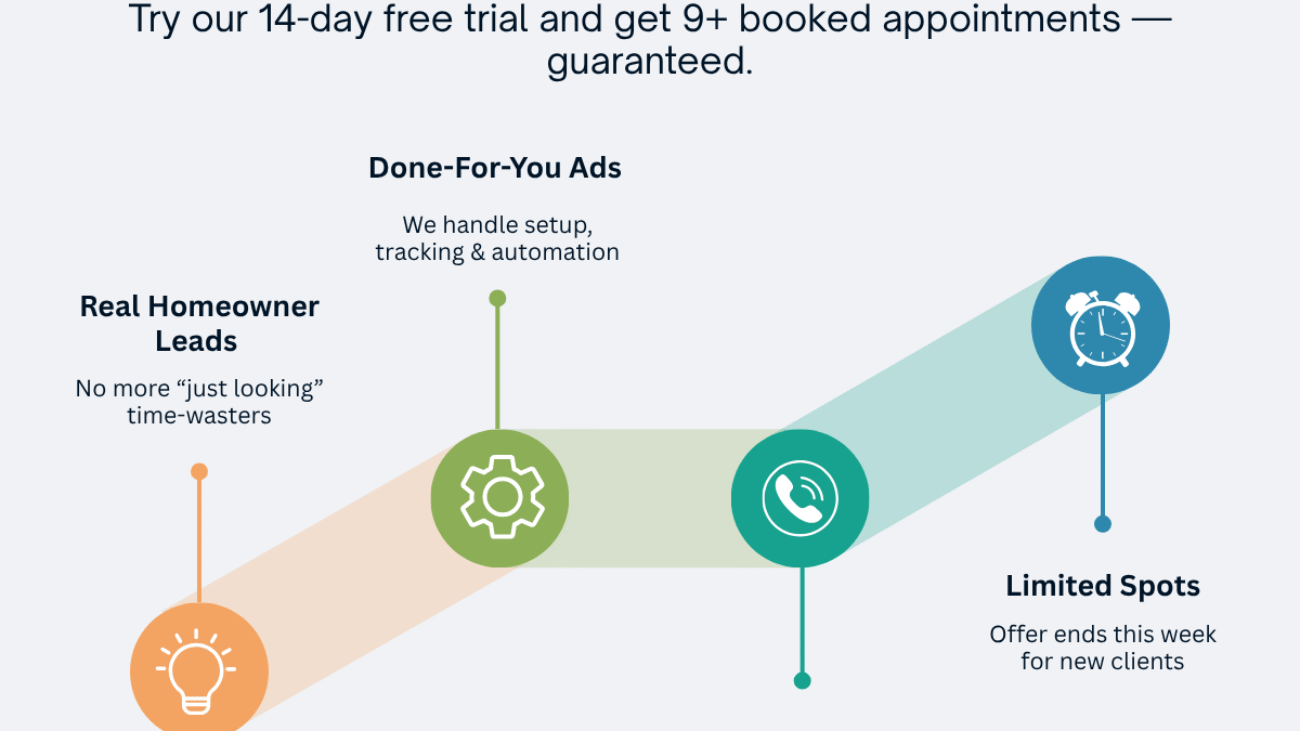
Get 9 or more booked appointments every month — or you don’t pay a cent.

That’s not marketing fluff — it’s a performance-based promise. If we don’t deliver, you keep your money. Simple as that.


What Happens During Your 14-Day Free Trial

We know roofers are busy. That’s why the setup is completely hands-off for you.

During your free 14-day trial:

✅ We launch your ads and manage everything behind the scenes
✅ You get access to a custom dashboard showing your live leads
✅ Our automation starts booking qualified appointments straight to your phone or calendar
✅ You’ll see exactly how the system works — and how fast it fills your schedule

By the end of the trial, you’ll know whether this system fits your business. No pressure, no risk. Just real results you can measure.


Real Results From Roofers Like You

Roofers across the U.S. and Canada have already seen this system change their business:

  • Mike from Florida went from struggling to get 3 leads a week to booking 12 qualified appointments in the first month.
  • Jared from Texas closed 5 jobs in 14 days using our follow-up automation — without making a single cold call.
  • Ahmed from Ontario finally turned off his old ad agency after realizing our system generated higher-quality leads at half the cost.
  • Read all our reviews here

These aren’t overnight miracles — they’re what happens when your marketing is actually built to convert homeowners, not just attract traffic.


Why We Limit Spots (And Why It’s Smart to Act Now)

We only onboard a few new roofing clients each week — and that’s for a reason. Our system runs locally, meaning we don’t take two competing roofers in the same area. When your zip codes are locked in, they’re yours.

That’s why we always say: once a spot is gone, it’s gone.

If you’re serious about growing your roofing business — and tired of gambling on ads that don’t pay off — this is the moment to act.


Final Thoughts: You Deserve Predictable Leads, Not Guesswork

Roofing is already tough work. Your marketing shouldn’t be. You deserve a system that brings leads consistently, without wasting hours chasing people who’ll never buy.

That’s what our Roofing Lead Generation System does — it brings in real homeowners, automates your follow-ups, and fills your schedule with qualified appointments.

Ready to try it for yourself?

🚨 This week only, we’re offering a 14-day free trial for new roofing businesses. No setup fee. No contract. Just results.

👉 Click here or send a message with the word “ROOF” on our contact page to claim your free trial and lock in your area before it’s taken.

Stop chasing quotes. Start booking jobs.
Your next 9 roofing appointments are waiting.

5 Roofing Ad Metrics You Can’t Afford to Ignore

5 Roofing Ad Metrics You Can’t Afford to Ignore

Running ads for your roofing business without tracking the right numbers is like climbing a ladder with your eyes closed—you’ll waste energy, take unnecessary risks, and likely miss your goal. Many contractors think “more clicks” or “more impressions” equals success. The truth is, those surface-level stats don’t put money in your pocket. What matters is how efficiently your ad dollars turn into real roofing jobs.

In this article, I’ll break down the five key metrics every roofing business owner must track to stop wasting money and start booking more jobs.


Why Most Roofers Struggle With Ads

Let’s be honest—Google and Facebook make it easy to spend money. You can launch a campaign in minutes, but if you’re not careful, that money disappears faster than a summer storm.

Too many roofers focus only on:

  • Clicks (“Wow, my ad got 500 clicks!”)
  • Impressions (“10,000 people saw my ad!”)

Neither of these metrics guarantee you’ll get a single booked job. That’s why your ad budget can feel like a gamble.

The good news? Once you start tracking the right numbers, you’ll know exactly what’s working—and what’s not.


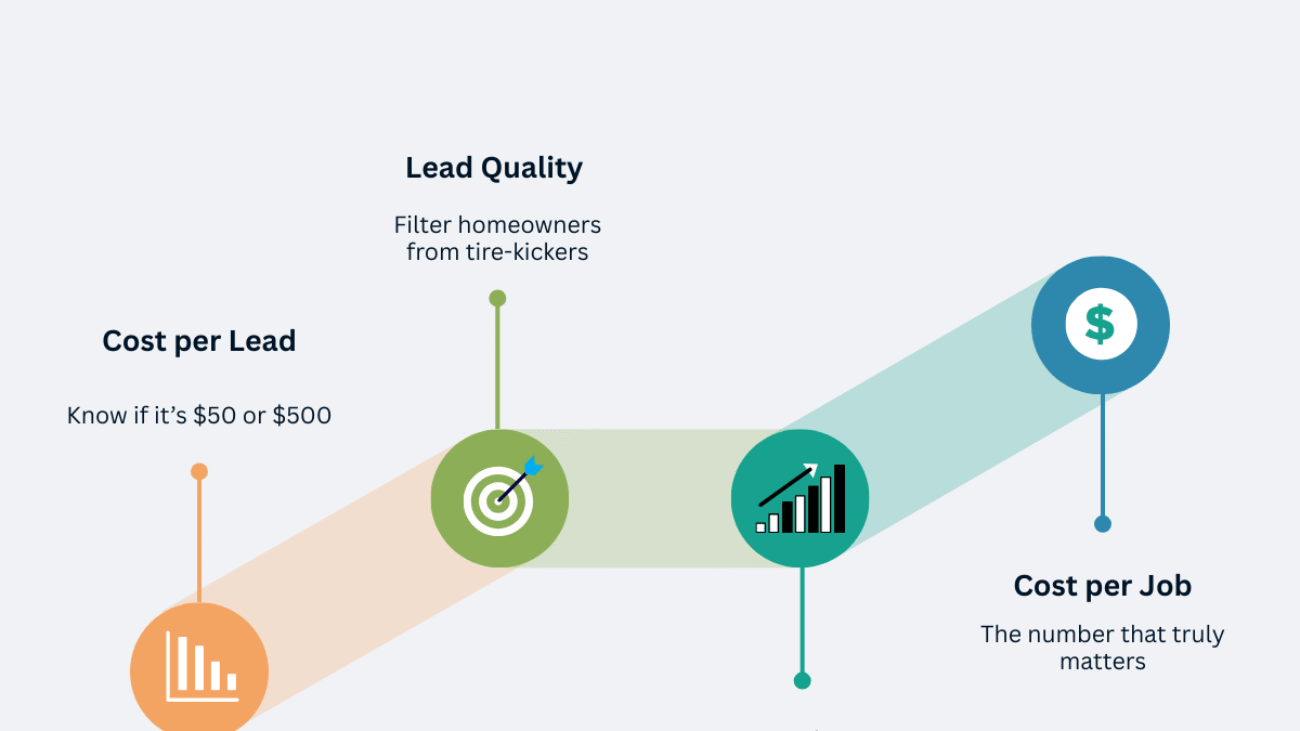
1. Cost Per Lead (CPL)

This is the first number you should care about. It tells you how much you’re paying for each phone call, form submission, or message that comes through your ad.

  • Example: If you spend $1,000 on ads and get 20 calls, your cost per lead is $50.
  • If another roofer spends the same $1,000 but only gets 2 calls, their cost per lead is $500.

Why it matters: If your CPL is too high, your ads are either targeting the wrong people or the landing page isn’t convincing. Fixing this can save you thousands.


2. Lead Quality

Not all leads are created equal. A curious renter clicking your ad is not the same as a homeowner with a leaking roof.

Signs of low-quality leads:

  • People asking general questions but not booking
  • Wrong service area inquiries
  • Calls from renters, not homeowners

Signs of high-quality leads:

  • They’re ready to schedule an inspection
  • They own the property
  • They’re in your target service area

How to improve quality: Use better ad targeting, clear messaging, and pre-qualifying forms (“Are you the homeowner?”).


3. Conversion Rate

Leads are great, but how many actually turn into booked jobs? That’s your conversion rate.

  • Example: You get 20 calls, but only 5 book a job = 25% conversion rate.
  • Another roofer gets 20 calls and books 10 = 50% conversion rate.

Why it matters: A higher conversion rate means you’re not just attracting leads—you’re attracting the right leads and closing them effectively.

Pro tip: Train your office staff or sales team on how to handle calls. Many roofing businesses lose jobs not because of bad ads, but because the calls weren’t handled properly.


4. Cost Per Booked Job

This is the number that truly shows whether your ads are profitable.

  • Example: You spend $1,000 and book 4 jobs = $250 per job.
  • If each job brings in $2,000 profit, your ads are a goldmine.
  • But if you spend $1,000 and book only 1 job, you’re at $1,000 per job—that’s tough to sustain.

This is the metric that separates “busy ads” from “profitable ads.”


5. Customer Lifetime Value (LTV)

One of the biggest mistakes roofers make is treating every job like a one-and-done. In reality, one good customer can be worth far more than the first project.

Think long term:

  • A roof repair customer may come back for a full replacement in 2–3 years
  • Happy customers give referrals (neighbors, family, coworkers)
  • Upsells (gutters, siding, maintenance plans) increase revenue

If your average customer is worth $5,000–$10,000 over time, paying $300 to acquire them suddenly feels like a bargain.


Bringing It All Together

Here’s the truth: running ads without tracking these five metrics is like playing poker blindfolded. You might get lucky, but chances are you’ll lose more than you win.

When you know your:

  • Cost per lead
  • Lead quality
  • Conversion rate
  • Cost per booked job
  • Customer lifetime value

…you gain clarity. You’ll know which ads to scale, which ones to cut, and how much you can confidently invest to grow your business.


Final Thoughts

Roofing is competitive, and the companies winning aren’t necessarily spending the most on ads—they’re the ones tracking the right numbers and making smart decisions.

If you’ve been frustrated by ads that “don’t work” or feel like money disappears without results, it’s time to stop guessing.

👉 Want to see how these five metrics apply to your roofing business? Book a free strategy call today, and I’ll walk you through where your ad dollars are going—and how to turn them into reliable roofing jobs.